Quordle Merriam-Webster: Official Daily Game Guide & Tips
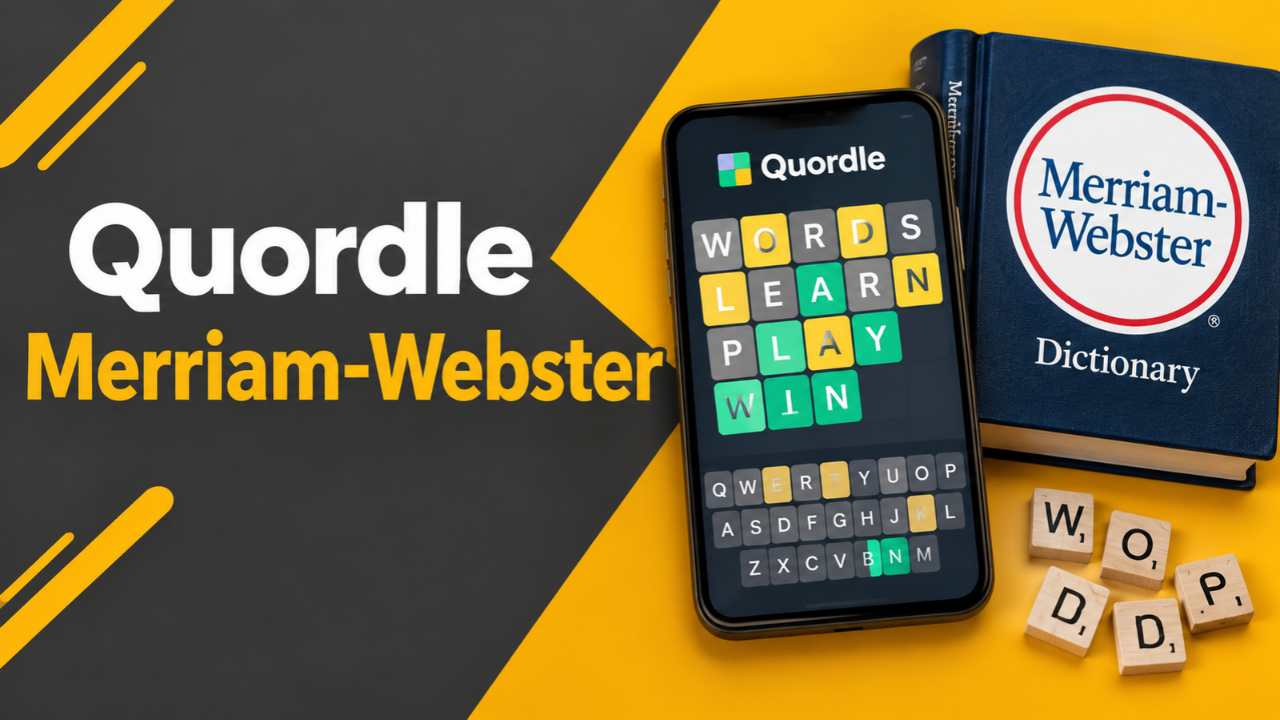
Quick Answer: Quordle Merriam-Webster is the official home of the popular four-word daily puzzle. Merriam-Webster acquired the game in early 2023 and hosts it free on its website at merriam-webster.com/games/quordle. Players solve four five-letter words at once using shared guesses and familiar color feedback.
The daily game works by applying every five-letter guess across all four grids simultaneously. Classic mode gives nine tries. Extra modes like Chill, Extreme, Sequence, and Rescue offer different difficulty levels and formats. A new puzzle appears each day.
Players can expect a free browser experience with no account required, clear color clues (green for correct position, yellow for wrong position, gray for absent), stats tracking, and a clean interface. It sits alongside other Merriam-Webster word games and dictionary tools.
Ever stare at a single five-letter grid and think, “This is too easy”? That restless feeling is exactly why so many people discovered Quordle Merriam-Webster. Instead of one word, you face four at the same time. One guess lights up all four boards. Nine chances (in the classic version) stand between you and the solution. The official home is Merriam-Webster’s own site, the same trusted dictionary brand that has defined American English for generations. What started as a clever Wordle spin-off now lives under one of the most credible names in language.
This guide walks through where Quordle Merriam-Webster lives, how the daily game actually works, and what you can expect the moment you open it. No fluff. Just clear steps, practical tips, and the kind of detail that helps both brand-new players and daily veterans.
Where Quordle Lives Today: The Merriam-Webster Connection
In January 2023 Merriam-Webster acquired Quordle. The standalone site redirected to the dictionary’s Games section. That move mattered. Suddenly the four-board puzzle sat next to Word of the Day, vocabulary quizzes, and the official dictionary itself. Credibility rose overnight.
The official URL is straightforward: https://www.merriam-webster.com/games/quordle/. Bookmark it. You do not need an account. You do not need an app. Open any modern browser on phone, tablet, or desktop and you are ready. The page loads the current day’s Classic puzzle by default, with buttons for other modes sitting right beside it.
Merriam-Webster kept the core free. No paywall has appeared for the daily games. Ads may show, but the puzzle itself stays open. That decision aligned with the company’s long habit of offering free language tools. Players who already trusted the dictionary for definitions found a natural next step in the games tab.
The acquisition also brought stability. Independent Wordle clones sometimes vanished or changed hands quickly. Quordle Merriam-Webster gained a permanent institutional home. New modes appeared over time: Chill for easier play, Extreme for tougher words, Sequence for one-at-a-time solving, and Rescue for fixing a scrambled board. A Weekly Challenge unlocks after you solve a Classic puzzle. All of it sits under the same clean Merriam-Webster design.
How the Daily Game Works: Rules in Plain Language
Open the page and you see four empty five-letter grids arranged in a two-by-two square. Your job is to fill every grid with the correct hidden word before the guess limit runs out.
Here is the core loop:
- Type any valid five-letter English word.
- Press Enter.
- That same word appears on all four boards at once.
- Each board colors its own letters independently.
- Green means the letter is correct and in the right spot for that specific word.
- Yellow means the letter belongs in that word but sits in the wrong position.
- Gray means the letter does not appear in that word at all.
Because the four secret words are different, the same letter can turn green on one board, yellow on another, and gray on a third. That simultaneous feedback is the entire point of Quordle Merriam-Webster. You cannot solve the boards one after another in Classic mode. Every guess costs a shared turn.
Classic mode gives nine guesses total. That works out to a little more than two guesses per word if you spread them evenly. In practice most players spend the first two or three turns on letter coverage, then lock in the boards that already show strong clues.
Other modes change the numbers:
- Chill: 12 guesses and generally friendlier words.
- Extreme: 8 guesses and more unusual vocabulary.
- Sequence: solve one word at a time, then move to the next.
- Rescue: the computer has already made a messy start and you clean it up.
A new set of four words appears every day at midnight local time for the Classic and related modes. Your streak, win percentage, and average guesses are tracked in the browser if you allow local storage. You can share a clean grid of colored squares after you finish, just like other daily word games.
Practice mode exists for unlimited play when you want to experiment without risking the daily streak.
What Players Can Expect When They Access Quordle Merriam-Webster
The first thing you notice is simplicity. The interface is clean. Four grids. A keyboard at the bottom or your physical keyboard. Color feedback that matches the Wordle language almost everyone already knows. No complicated menus. No forced tutorial that blocks the board.
Because Merriam-Webster hosts it, the page feels trustworthy. The same navigation that takes you to dictionary entries and thesaurus results also leads to the games. You can look up a word the moment a letter combination puzzles you, though most serious players prefer to finish first and check later.
Performance is solid on both mobile and desktop. The grids scale cleanly. Touch typing works. Physical keyboards work. Dark mode is available if the site supports it in your browser settings.
Daily rhythm becomes part of many players’ mornings. Some treat Classic as the main event and then try Chill or Extreme for variety. Others unlock the Weekly Challenge and treat it like a mini tournament. Stats accumulate quietly in the background. You see your current streak, longest streak, and how many times you have solved the puzzle in a given number of guesses.
Community sharing stays light. People post the emoji grids on social media. They compare strategies without spoilers. Some keep personal opener lists. Others simply enjoy the mental stretch of managing four boards at once.
Expect occasional tougher days. Four uncommon words can appear together. On those days the nine-guess limit feels tight. That is intentional. The game rewards careful information gathering more than lucky first guesses.
Smart Strategies That Actually Help
Most new players try to solve one board as fast as possible. That usually fails. Better approach:
Start with coverage. Choose opening words that test many common letters and all the vowels. Popular pairs include AUDIO followed by STERN, or SLATE followed by CORNY. Three-word openers push letter coverage even higher. The goal is not to solve anything yet. The goal is to light up yellows and greens across all four grids.
After two or three openers, scan the boards. Identify the one with the most solid information. Finish that board first. Once a grid is solved it stops accepting new letters, so every remaining guess focuses only on the unfinished words.
Keep a running mental note of letters that are gray on one board but still possible on others. A letter eliminated from the top-left grid may be the key to the bottom-right one.
Watch your guess count. If three boards still need work and only three guesses remain, you must convert quickly. Panic guesses rarely help. Stick to words that test remaining possibilities across multiple boards.
Practice mode is your friend. Use it to test new openers without pressure. Over time you will develop a personal sequence that feels natural.
Why Quordle Merriam-Webster Stands Out Among Word Games
Wordle made five-letter guessing mainstream. Dordle doubled it. Quordle quadrupled it and found the sweet spot. Four boards create real strategic tension without becoming impossible. Nine shared guesses force trade-offs that pure single-board games never demand.
Hosting under Merriam-Webster adds quiet authority. The dictionary brand signals that the word list is curated and the experience will remain available. Players who already visit the site for definitions find the game a natural extension of their language habit.
Compared with other multi-word clones, Quordle Merriam-Webster offers polished modes, consistent daily resets, and a clean sharing format. It does not require downloads or logins. It works on whatever device you already use.
The game also rewards vocabulary growth. Unusual words appear often enough that players gradually expand their five-letter repertoire. Looking up a solved word afterward becomes part of the fun for many.
Common Myths and Real Answers
Myth: You need perfect English knowledge to win.
Reality: Strong letter strategy beats rare vocabulary on most days. Coverage first, then targeted solves.
Myth: The game is just Wordle times four.
Reality: The shared guess pool changes everything. Information management matters more than pure word knowledge.
Myth: You must solve the boards in order.
Reality: Classic mode treats all four as simultaneous. Sequence mode is the only one that forces order.
Myth: Merriam-Webster will put it behind a paywall soon.
Reality: The company has kept the daily games free since the 2023 acquisition. No public plans have reversed that.
Next Steps for New and Returning Players
- Open merriam-webster.com/games/quordle/ right now and try today’s Classic puzzle.
- Pick two solid openers and play them every day for a week. Track how the coverage improves.
- After each solve, glance at the revealed words. Note any that were new to you.
- Try Chill mode on a tough day to rebuild confidence.
- Share a finished grid with friends and compare strategies without revealing answers.
- Use practice mode to experiment with three-word openers.
- Check back for the Weekly Challenge once you finish Classic.
The four boards will feel overwhelming at first. Within a few days the rhythm becomes familiar. You start seeing patterns across grids instead of staring at one board in isolation. That shift is the real pleasure of Quordle Merriam-Webster.
Frequently Asked Questions
Is Quordle Merriam-Webster free to play?
Yes. The daily modes are free in the browser. No account or payment is required.
How many guesses do I get in Classic mode?
Nine shared guesses for four words.
Where is the official site?
https://www.merriam-webster.com/games/quordle/
Can I play on my phone?
Yes. The site works well on mobile browsers.
What do the colors mean?
Green: correct letter in correct position for that word. Yellow: letter is in the word but wrong spot. Gray: letter is not in that word.
Is there a practice or unlimited mode?
Yes. Practice mode lets you play as many puzzles as you want without affecting the daily streak.
Does Merriam-Webster own Quordle?
Yes. The company acquired it in January 2023 and hosts the official version.
What happens if I only solve three of the four words?
That counts as a loss for the day. All four must be solved within the guess limit.