Skip to content
  • Home
  • About Us
  • Privacy Policy
  • Contact
Quordle

Explore more, every day.

  • Home
  • Quordle
    • Quordle Merriam-Webster
    • Quordle Today
  • Quordle Blogs
  • Apps & Games
  • Business
  • Tech
  • Health
  • Education
  • Home Improvement

Quordle Blogs

Home » Quordle Blogs
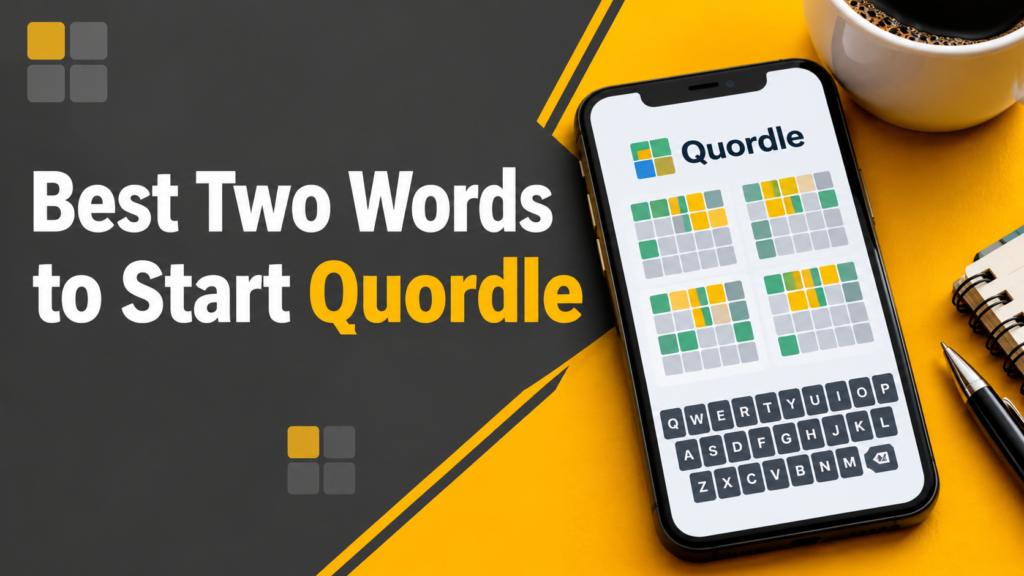
Best Two Words to Start Quordle
Posted inQuordle Blogs

Best Two Words to Start Quordle: Winning Openers

Finding the best two words to start Quordle can turn that daily puzzle from a scramble into a confident, information-rich start. The right pair does not try to guess any…
Posted by Quordle Team October 2, 2026

Recent Posts

  • Best Two Words to Start Quordle: Winning Openers

Categories

  • Quordle Blogs

Quick Answer: Quordle is a free browser-based word game that asks players to solve four hidden five-letter words simultaneously. Every guess you type appears on all four grids at once, and color feedback (green for correct position, yellow for right letter wrong spot, gray for absent) appears independently on each board. You get nine total attempts in classic mode to finish every word.

Created in early 2022 by Freddie Meyer from a prototype by engineer David Mah, Quordle rode the Wordle wave and quickly drew hundreds of thousands of daily players. Merriam-Webster acquired it in January 2023, and it now lives on the dictionary site’s games section. No account or download is required.

People play Quordle for the extra mental challenge, the daily shared experience, and the satisfaction of juggling multiple puzzles under pressure. It sharpens vocabulary, pattern recognition, and strategic thinking in a short session that usually lasts five to fifteen minutes.

What Is Quordle?

Quordle takes the familiar five-letter guessing format made famous by Wordle and multiplies it by four. Instead of one secret word, four different five-letter words sit hidden across a 2x2 grid of boards. You type a single valid English five-letter word, and that same guess fills the next empty row on every board. Each board then colors its tiles based only on its own hidden answer.

Green means the letter sits in the exact right spot for that word. Yellow means the letter belongs somewhere in the word but not where you placed it. Gray means the letter does not appear in that particular word at all. Because the boards work independently, the same letter can turn green on one grid, yellow on another, and gray on the remaining two. That multi-layered feedback is the heart of the game.

A new set of four words appears every day at the same time for all players. Once you finish (or run out of guesses), you can copy a grid of colored squares to share your result without spoiling the answers. Practice mode lets you play unlimited random sets so you can hone strategy without waiting for the next daily puzzle. Other modes such as Sequence (one board unlocked at a time), Chill (more guesses), and Extreme (fewer guesses) add variety for different moods or skill levels.

The game stays completely free. You open the official page on the Merriam-Webster site, start typing, and play. No sign-up, no ads that interrupt the flow, and no paywall for the daily challenge or practice.

What Makes Quordle Different from Other Puzzle Games?

Most daily word games follow a single-target model. Wordle gives you six guesses for one word. Dordle doubles that to two words with seven guesses. Quordle jumps to four words and nine guesses. The math looks generous at first glance, yet the shared guess pool makes it tighter than it appears. You average roughly 2.25 guesses per word, so early exploratory plays matter far more than in single-board games.

The simultaneous application of every guess creates a unique cognitive load. In Wordle you can safely burn a guess to test rare letters. In Quordle that same guess costs progress on three other boards. Players learn to prioritize high-information openers that cover common vowels and consonants across all four words at once. Later guesses often serve dual purposes: closing one nearly solved board while still gathering data for the others.

Compared with larger multi-board games such as Octordle (eight words), Quordle sits in a sweet spot. It feels substantial without demanding half an hour of focus. The interface stays clean: four compact grids, an on-screen keyboard that reflects the combined letter status in a smart multi-color way, and clear visual separation once a board is solved. Solved boards lock and stop accepting further input, so your remaining guesses focus only on the unsolved ones.

Another difference lies in the word list and difficulty curve. Because four answers must be chosen each day, obscure or less common five-letter words appear more often than in the tightly curated Wordle list. That keeps the challenge fresh and rewards a broader vocabulary. At the same time, the daily nature and shareable results create the same social ritual that made Wordle a cultural phenomenon: people compare streaks, debate tough words, and post their colored grids.

What Is Quordle Used For?

Primarily, Quordle serves as daily mental exercise. Regular players report sharper pattern recognition, better letter-frequency awareness, and improved ability to hold multiple possibilities in working memory. The short time commitment makes it easy to fit into a morning coffee break, a lunch pause, or a wind-down routine before bed.

Teachers and language learners sometimes use it as an informal vocabulary tool. The forced exposure to four new or less familiar words each day expands word banks without feeling like study. Parents and older adults enjoy it as a low-pressure cognitive activity that stays engaging over months and years.

Socially, Quordle functions like many other daily puzzles. Friends and online communities share results, swap starting-word strategies, and celebrate rare perfect scores (all four words in fewer than nine guesses). Some workplaces or family groups turn the daily puzzle into a friendly competition. Because results show only the pattern of colors and the number of guesses used, discussion stays spoiler-free until everyone has finished.

Beyond pure entertainment, the game trains a transferable skill: resource allocation under constraint. Every guess is a limited resource that must serve multiple goals. That kind of thinking appears in project planning, budgeting, and even everyday decision-making. Of course, most people simply play because it is fun and just hard enough to feel rewarding when the last board turns green.

Who Uses Quordle?

The player base overlaps heavily with Wordle fans who wanted more challenge. Office workers, students, retirees, and puzzle enthusiasts of many ages log on each day. Because the game runs in any modern browser on phones, tablets, or desktops, it reaches people who never download apps.

Competitive solvers and streak hunters form a dedicated subset. They track consecutive daily wins, refine opening strategies, and sometimes post detailed breakdowns of how they approached a particularly tough set. Casual players make up the larger group. They enjoy the daily ritual, accept that they will not always finish in nine guesses, and simply like the mental stretch.

Language professionals, editors, and writers often appreciate Quordle because the broader word list surfaces less common terms. Teachers occasionally recommend it to students as a fun way to practice spelling and letter patterns. Accessibility is high: the color system works for most players, and the keyboard provides additional visual feedback. No special hardware or high-speed connection is required.

Since the Merriam-Webster acquisition, the game has stayed free and widely available, so the audience continues to grow among people who already visit the dictionary site for definitions or other word games.

How Does Quordle Work?

The core loop is simple yet demanding. You open the daily puzzle and see four empty five-by-nine grids arranged in a square. An on-screen keyboard sits below. You type any valid five-letter English word and press Enter (or tap the enter key). Instantly the word appears in the current row of every grid. Each grid then colors its five tiles according to its own hidden answer.

After the first guess you study the four sets of colors. Some boards may already show promising greens or a cluster of yellows. Others may be mostly gray, telling you that particular word uses a very different set of letters. Your next guess must balance the needs of all four boards. Strong players often spend the first two or three guesses on high-coverage words that test many common letters rather than trying to solve any single board early.

As boards get solved they lock. Future guesses no longer appear on finished grids, which frees mental bandwidth for the remaining words. If you reach the ninth guess with any board unsolved, the game reveals the missing answers and ends. A clean win requires all four words within the nine attempts.

Keyboard feedback is clever. Letters can display multiple colors at once if their status differs across boards. This helps you track which letters are still viable for which words without constantly scanning every grid. Practice mode removes the daily limit so you can experiment with different openers or recover from a tough loss.

The entire experience runs client-side in the browser. Your progress for the daily puzzle is stored locally, so you can close the tab and return later the same day without losing your place. Results can be copied as a grid of emoji-style colored squares for easy sharing on social media or messaging apps.

How Do You Join a Quordle Game?

Joining could not be simpler. Point any modern browser to the official Quordle page on the Merriam-Webster games section. The daily puzzle loads automatically. No registration, login, or app install is needed. On a phone the layout adapts cleanly; on a desktop the four grids sit comfortably side by side.

If you prefer practice or alternative modes, the interface offers clear buttons or menus to switch. Sequence mode, for example, shows only one board at a time and unlocks the next after you solve the current one, with a slightly different guess allowance. Extreme and Chill adjust the total number of guesses for players who want more or less pressure.

Once the grids appear, simply start typing. If you are new, try a balanced opening word rich in vowels and frequent consonants. After each guess, pause to read all four color patterns before choosing the next word. Many players keep a mental or written note of confirmed greens and remaining yellows for each board.

When you finish, the share button lets you copy your result. Past daily puzzles are often available through an archive or practice options, so you can replay older challenges if you missed a day. Because everything is free and browser-based, “joining” really just means opening the page and playing.

Practical Strategies for Consistent Wins

Success in Quordle rewards information gathering over early heroics. A good first guess might include common letters such as A, E, R, S, T, L, N, O, and I. Second and third guesses should introduce remaining high-frequency letters while respecting any greens or yellows already found. Avoid wasting a guess on a word that only helps one nearly finished board if three other boards still need data.

Track letter status carefully. A letter that is gray on three boards but yellow on the fourth is still useful for that last word. Conversely, a letter green on one board may be completely absent from the others. Once two or three boards are close to solved, you can afford more targeted guesses. Many experienced players aim to lock two boards by guess six or seven, then focus the final attempts on the harder remaining pair.

Common pitfalls include tunnel vision on one board, repeating letters that have already been ruled out across most grids, and ignoring the keyboard’s multi-color clues. Taking a short pause after every guess to scan all four boards pays off. Over time your brain starts holding the four partial solutions more easily, and the daily puzzle becomes a satisfying routine rather than a stressful scramble.

Conclusion and Next Steps

Quordle delivers a deeper daily word challenge than single-board games while remaining approachable and free. Its four-board format, shared guess pool, and clean design create a unique blend of strategy and vocabulary skill. Whether you play for the mental workout, the social sharing, or the pure satisfaction of turning four grids green, the game rewards consistent practice and smart openers.

Here are five quick tips to get started or improve:

  1. Open with a high-coverage five-letter word that mixes common vowels and consonants.
  2. Use the second and third guesses to test remaining frequent letters rather than chasing one board.
  3. Lock easier boards early so later guesses can focus on the tough ones.
  4. Read the multi-color keyboard feedback carefully after every turn.
  5. Play a few practice rounds when you have time so the daily puzzle feels less pressured.

Try today’s Quordle, note how your strategy evolves, and share your result or favorite starting word in the comments. What is the hardest set of four words you have faced so far?

Frequently Asked Questions

Is Quordle free to play?
Yes. The official version on the Merriam-Webster site requires no payment, subscription, or account.

How many guesses do you get in Quordle?
Classic mode gives nine shared guesses to solve all four words. Other modes adjust that number.

Can I play past Quordle puzzles?
Practice mode and archive options let you replay older or random sets without affecting your daily streak.

Is Quordle harder than Wordle?
Most players find it significantly more challenging because of the four simultaneous boards and tighter effective guess ratio.

Do I need to download an app?
No. Quordle runs fully in any modern web browser on phone, tablet, or computer.

What happens if I solve one word early?
That grid locks and no longer accepts new guesses, so your remaining attempts apply only to the unsolved boards.

Who created Quordle?
Freddie Meyer released the game in February 2022 based on a prototype by David Mah. Merriam-Webster acquired it in 2023.

Copyright 2026 — Quordle. All rights reserved.
  • Home
  • About Us
  • Privacy Policy
  • Contact
Scroll to Top